Hospitality, by Phillip Hoyle

My
parents lived truly hospitable lives. As a couple striving to live within the
Christian and biblical tradition, they entertained strangers and travelers. They
knew the stories of heavenly visitors that sometimes showed up asking for a
meal or a place to spend the night. They were familiar with the Old Testament
story of Abraham and Sarah’s visit by angels and the New Testament
interpretation that the same thing could still happen. They read the biblical commendations
of individuals and churches that welcomed travelling prophets and evangelists. In
their own time they lived out the spirit of those old stories and
interpretations.
They
also entertained their children. Of course that idea is not caught up in the
hospitality laws and traditions of Hebraic antiquity, for in Jesus’ teachings
there was no righteousness in taking care of one’s children or parents. Anyone
with dependants simply was responsible for the attendant burdens. Yet when I
contrast my parents’ providence and attitudes toward their children with what I
know happens too often in other children’s families, my parent’s home shines as
a place of true hospitality toward progeny, offspring who were treated as
persons not property. Our home went beyond the ancient values that treated
wives and children as a man’s chattels, for my parents treated one another
humanely and their children as well. They also treated other people as human
beings of value, and thus they related responsively to and responsibly toward
them. Surely such a distinction can be listed as hospitality, extraordinary
hospitality.
I
enjoyed a great upbringing in a hospitable home environment. So did Myrna, my
wife. Upon coming together, we saw our home as an environment for rearing
children and entertaining friends and strangers. Thus we accepted foster children
and “foster” adults into our home. For five years we entertained, as it were,
foster children when we served as a boarding home for the Kansas Children’s
Service League, a group I knew about due to my mother’s long-time support of
them. We also welcomed relatives and friends to live with us while they went to
school: Myrna’s sister who attended medical assistant school, a foster-daughter
of my sister’s who attended cosmetology school, our friend Ted who attended
graduate school, an old classmate Donna who likewise attended graduate school,
and friends of our son and daughter, kids who needed familial support in
various ways. We welcomed a friend of our son’s who as a young adult lived with
us for several months, and we welcomed a slightly crazy woman to live with us
for several more months, a woman who seemed always to be almost one inch from
living on the street. These experiences among many others kept our house lively,
taught the two of us strength, adaptability, and perseverance. Our home became
a crash pad, a loving support, an oasis, a place of cross-cultural learning, a
bed and breakfast, and the center of loving tolerance. The experiences changed
our lives, our perceptions of social reality, and our willingness to take
chances on other persons’ lives.
I
wonder then why we were unable to enfold my homosexuality into such an enduring
relationship and environment. Perhaps hospitality and homophobia don’t mix well
and the antipathy against homosexuality is too well institutionalized in western
society, too highly integrated into myths of otherness, sin, and transgression.
Both my wife and I were surprised at how quickly we moved towards separation
when details of my sexual truth became extrovert. We remain friends and when
together still wonder why we live separately. We are both hospitable; using our
separate homes to benefit others, and we are pleased that our children do the
same. Still the question lingers.
An
elderly minister and I once discussed the injunction in Matthew’s Gospel that
allowed for a church to kick out a member who would not act right. The wise man
pointed out that according to other good news passages such a sinner had to be
welcomed just like a brother or sister. But somehow, when homosexuality enters
the picture, there emerges a deep rift of disappointment, dirt, despicability, disrespect,
and dire detriment, enough so as to rip apart an intergenerational, long-standing
love and hospitality. Obviously marriages are not magic; nor is hospitality
uncomplicated.
Hospitality
must have been very difficult for Rafael’s mother, yet eventually she welcomed
me into her life on behalf of her dying son.
She
had to enter the home he shared with his gay American partner, a man her own
age.
She
had learned of her son’s homosexuality only about three months before when he
was in legal trouble. Then she learned that her eldest son was gay, he was ill
with HIV, and soon after that he was living with an American man.
Rafael’s
father was warm. His brother was warm. His sister was warm. I had to read body
language to understand those things. His mother was not mean, but she wasn’t
warm towards me. Some of what I understood about her I learned from her son.
She was not happy with the situation. It was against the church. It was against
all her dreams for her son and all the expectations she had held for her own
life. Sure her son had fathered a son for her, but he was supposed to stay with
his family, not run off to America and live with some gay man.
Rafael
told his parents they were welcome to stay at our home while they were visiting
him, but I was part of the deal. They were to be our guests. Of course, he
didn’t make it home until we were arranging home hospice for him. Then he
stayed less than thirty hours for when the home nurse tried to insert a
catheter to his bladder, she got blood. He had just been diagnosed with
full-term Hepatitis C.
Cultural
expectations were going to be a problem. I did housecleaning although I knew it
was women’s work. Once his father invited me to come sit with him. Of course we
could not talk. He wanted things to be as normal and proper as possible with
his wife and daughter doing the cooking and cleaning.
I
too was gracious and hospitable.
I
have received the hospitality of strangers.
I
have received strangers into my hospitality.
Home
life and hospitality.
Myrna:
Hospitality and generosity.
OT
traditions, NT traditions.
Users
and the hospitable, the foundation of a prejudice.
Hospitality
and spiritual dimensions of growth.
Pragmatic
considerations in hospitality.
Jesus’
words of hospitality—both to receive it and give it. Holy images.
Hospitals
Hostels
Hosts
Invitations

© 12 Mar 2013 
About the Author 
Phillip Hoyle
lives in Denver and spends his time writing, painting, and socializing. In
general he keeps busy with groups of writers and artists. Following thirty-two
years in church work and fifteen in a therapeutic massage practice, he now
focuses on creating beauty. He volunteers at The Center leading the SAGE
program “Telling Your Story.”
He also blogs at artandmorebyphilhoyle.blogspot.com
The Females in My Life, by Ricky

Like everyone else on
this planet, the first woman in my life was my mother.  Mom was the care giver when I was young, but
she was also the rat-fink of my life. 
She would always tell my father of my daily misdeeds and he was the
disciplinarian in the family.  During
that time period, discipline consisted of not too gentle spankings, so I
learned to fear both of them.  Mom was
also the one who came to Minnesota, while I was living with my grandparents, to
be a bridesmaid for her sister and then did not take me back to California when
she left Minnesota after the wedding.  I
think I subconsciously resent her even to this day for leaving me and for being
a rat-fink.
The second woman was my
father’s mother.  After I was born she
came to live with us for about one year. 
I don’t remember that time period much and as I grew up, I did not see
her very often.  The next female in my
life was my beloved Bonnie, a black and white collie, who became the best baby
sitter a two-year old toddler could not escape; that is until I learned to take
her with me when I left the yard.  Sadly,
she got distemper and passed before her first birthday.  I don’t remember if I grieved for her very
much.  I only now remember her from old
photographs and the stories my parents told me over time.
Next was a girl in my
Kindergarten class at the Hawthorn Christian School in Hawthorn,
California.  Her name was Sandra
Flora.  She was like a girlfriend to me,
or more precisely, I was a boyfriend to her. 
With long curly hair and the full dress that little girls wore at that
time, she looked like a young Shirley Temple. 
I carried her Kindergarten school photo in my wallet well into my 40’s
when I finally lost it.
The next woman in my
life would be my mother’s mother.  I
lived with her and my grandfather for two years on a farm in central Minnesota
from the age of 8 until two-weeks before I turned 10.  She was a reasonable surrogate mother but at
9-years of age, I ended up with a mild ‟school boy crush” on my 4th
grade teacher, Mrs. Knoll.  She was a
very young beautiful lady and in her second year as a teacher.  The crush was mild because she was married so
I knew I had no chance and I was not quite into full blown puberty.  My 3rd grade teacher, Mrs.
Sorensen, was a good but matronly teacher and thus of no interest to me.
Back on the farm, my
aunt Darlene, my mother’s younger and only sister, would visit occasionally
with her husband.  When I was 8, I was a
ring-bearer (like Bilbo and Frodo) at her wedding.  My younger cousin, Pamela Anderson, was the
flower-girl.  There was one other female
on the farm that I had a platonic relationship with, at least on my part.  Her name was Peanuts and she was a Guernsey
cow.  Her stall was the first one as I
would enter the barn and so she became my favorite, almost like a pet.
One week before I
turned 10, my mother and new step-father came to Minnesota to pick me up and
take me back to California.  They also
introduced me to the next female to enter my life, my little baby sister,
Gale.  For the next 9 years she and her
twin brother and I had a close family relationship.  They were the kids and I was the
babysitter.  Not too much personal time
for me, but we did have some amount of fun growing up until I went away to
college and then the military.  She still
lives at our ‟home town” of South Lake Tahoe.
The next female was
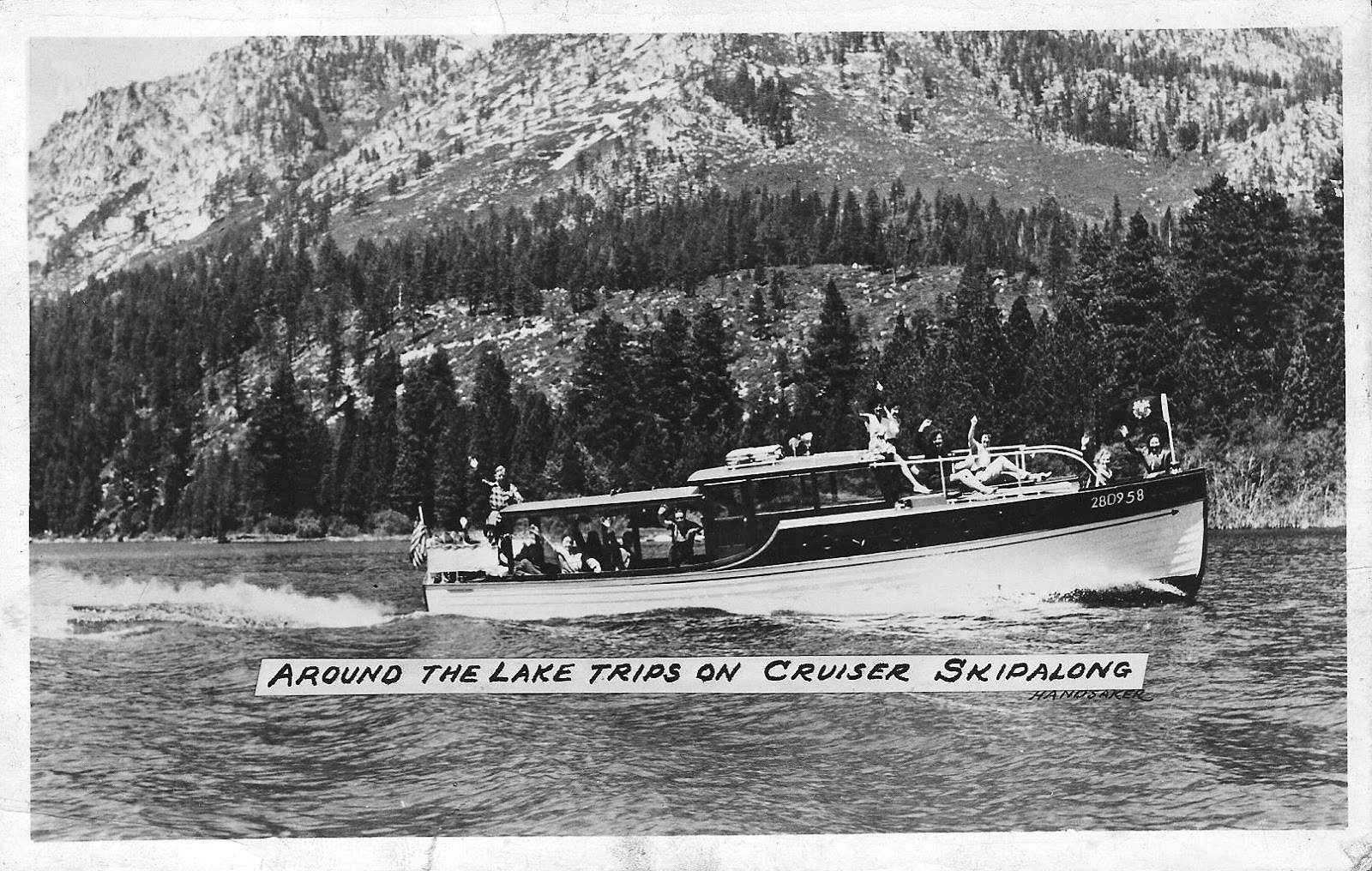
never alive in the literal sense but she really was a lady.  She was the Skipalong, my step-father’s 39
foot cabin cruiser he used as a tour-boat on Lake Tahoe during 1957 and ’58.  I was his deckhand in 1958 and I
really loved the ‟job” and the boat.  All
I had was that one summer with her as the next summer, at the beginning of the
season, she sank at a pier while her engine was being overhauled and was sold
for salvage.  I still miss her even today
as that summer was perhaps the happiest of my childhood.


She had a colorful career.  It is
believed she was built in the 1920’s in Morris Heights, New York by the
Consolidated Shipbuilding Corporation. 
She was originally 36 feet long but upon arrival in San Francisco she
was modified to 39 feet long and a ‟lookout cockpit” was added to the bow as
she began service as a rum runner during Prohibition.
In the Fall of 1958,
after that wonderful summer, I developed another school boy crush.  This time it was during full blown puberty
and on my unmarried, first year 5th grade teacher, Miss
Herbert.  She was beautiful, young, and
had a wonderful personality.  I was in
LOVE!  Then she got married over
Christmas vacation.  I was
devastated.  It appeared to me that I
would never get the women I loved, which due to the age differences, is
probably a good thing.
The next female arrived
at our house on Red Lake Road, in South Lake Tahoe when I was 12.  She was ¾ Oriental Poodle and ¼ Pomeranian—a
little, black, shaggy, and “yippy” lap dog. 
She bonded to me the first night in our house and became the first
female I slept with for the next 9-years. 
I was monogamous but she was a very prolific bitch. No! I was not the
father of her litters.
After I joined the Air
Force, I met my first girlfriend as an adult. 
She was the best friend of the woman I would marry 5-years later.  During the intervening years, I also met the
woman who taught me about making out and foreplay.  Then there was the woman who took my
virginity.  Actually, I guess it was a
mutual thing as she did not have to twist my arm to get it.
Then I married Deborah
and we enjoyed 27-years and 9-months together before she passed from complications
of breast cancer.  During those years,
the final women in my life were born to us—our three daughters, one of which
made me a grandfather with her 2-daughters.
So those are the women
and other females in my life.  I chose
not to tell about my two female cats, so be thankful for small favors.
© 23 November 2014  
About the Author 
I was born in June of 1948 in Los Angeles, living first in Lawndale
and then in Redondo Beach.  Just prior to
turning 8 years old in 1956, I was sent to live with my grandparents on their
farm in Isanti County, Minnesota for two years during which time my parents
divorced.
When united with my mother and stepfather two years later
in 1958, I lived first at Emerald Bay and then at South Lake Tahoe, California,
graduating from South Tahoe High School in 1966.  After three tours of duty with the Air Force,
I moved to Denver, Colorado where I lived with my wife and four children until
her passing away from complications of breast cancer four days after the 9-11-2001
terrorist attack.
I came out as a gay man in the summer of 2010.   I find writing these memories to be
therapeutic.
My story blog is, TheTahoeBoy.Blogspot.com.

Three Dollar Bill, by Ray S

Possibly
this has happened to you at some time. You go to the storage room in search of
some sort of old legal paper stored for safety because you couldn’t tell when
you might need it.
The
other day this became my mission. So I was buried in a collection of storage
boxes and file boxes searching for a copy of a paid mortgage.
Of
course, I became completely diverted by a box of old photographs: portraits and
snapshots. At the bottom of this box I found a thin blue book titled “Our Baby”
complete with faded pictures and notes.
Curiosity
got the best of me, so I settled down to read the writer’s detailed description
of the baby’s arrival, weight (7 lbs.), length (21”), etc, as well as the
mother’s pleasure about the food and rest she’d gotten in the hospital. Then
there was the list of gifts and their donors, and a ribbon-tied bundle of
letters and cards.
At
this point I decided the latter was too much a tackle and put it back into its
niche. At this point I saw a yellow envelope that had been hidden by those
cards and letters.
The
printed name on the envelope read “Western Union Telegraph” and was addressed
to Mr. J. W. Wulf, Cleveland, Ohio. It was a copy for the sender’s file. Of
course, I had to read the enclosed telegram.
The
message stated:
Ray
Wulf arrived 11:35 AM
Oct
19, 1926, Berwyn Hospital
Berwyn,
Illinois
Baby
and mother doing fine.
Signed
Homer E. Sylvester
It
was the everlasting three dollar bill, where or from whom it came from, but it
has lasted for 90 years.
© 14 March 2016 
About
the Author
 

Practical Joke, by Phillip Hoyle

Recalling clearly my eldest sister’s evaluation of the girls in her dorm five years before, [“They’re all so immature,” she said,] I wondered what I’d find in the boys dorm at the same small church-related college in north central Kansas five years later. Would there be a lot of horseplay, silliness, competition? Would the talk be rough, derisive, pious? I was pretty excited by the prospect of living around so many other guys because I had no brothers. Would I find a brother there? If so, would I like it? Who would I room with? Questions. What would be the answers? I already knew a little about the small burdens in that dorm, of needing to keep the room clean in order to pass periodic inspections, to fulfill duties of dust mopping hallways, straightening lounges, or cleaning shower rooms. Would I enjoy bull sessions?

I trudged up the steps of the rather new dorm toting my bags and boxes, depositing them in my room. Then in came my roommate—Roy his name—from a small southwest Kansas town out in the Great Plains where one can drive for a hundred miles without seeing trees or hills, where the wind blew without stop, where he attended a school with one hundred students including elementary and high school. I was lucky for, like me, Roy was studious, a seriously mature student. That helped both of us to get in good shape academically. And he was nice this slender, strong, black haired boy with a resonant voice and good manners. And he was clean.

I came to school with a stereo, a small LP collection, artwork to hang on the dorm room wall, and a two-drawer file cabinet. He came with some books, a basketball, running shoes, and a car. I came with years of musical experience; he with years of playing high school sports. We had both worked regular jobs. We shared our room, shared respect, and shared some classes for we were both ministerial students. We got along well.

Roy was athletic. He’d been the all-around great student in his graduating class: going out for all the sports, singing in the choir, dating the girls, even entering the state speech and debate tournament where he presented an interpretation of T. S. Elliot’s “The Hollow Men” for which he was awarded recognition. My eighteen-year-old mind didn’t grasp that serious poem; I wonder if his did. Some nights when Roy and I were studying in the dorm, he at his desk beneath the window, I in the middle of the room, I’d notice the floor vibrating. The first time I looked up for an explanation, I found Roy unconsciously bouncing his legs, setting the room shaking. This nervous habit may have been related to his fast speech, his hand movements when making some point, his fast metabolism that kept him slender.

There were some shenanigans in the dorm; what else would one expect from a group of undergraduates thrown together in close proximity with dorm hours that gathered us in at 10:00 pm. There was the din that finally quieted around 11:30. There were wrestling matches organized at odd hours. In general, we lived surrounded by other guys about our age, nice guys at that.

I noticed that most afternoons at the same hour Roy would return to the room following one of his classes. That particular afternoon I was reading at my desk when I got the idea, surely inspired by a current scary movie or simply by remembering life at home where one of us kids would scare another. I wondered if I’d really pull the practical joke becoming as immature as some of my dorm mates. When Roy was due to return, I turned off the light, crawled under his bed, and waited. It seemed a long wait, but finally the door opened. Roy walked over to put his books on his desk, then opened his closet door. All I could see were his feet. I was trying to figure out how most effectively to scare him: scream, grab, jump? Waiting I decided simply to reach out and clasp his ankles. Finally he took a step toward the bed and turned around into the perfect position with his back turned. I reached out, clasped his ankles and said nothing.

He said something, probably not anything he’d say from the pulpit, and screaming jumped. I suppressed my laughter and crawled from my hiding place. That was it. Fortunately Roy didn’t faint, and the practical joke did not end our friendship. It probably didn’t strengthen it though. We lived together two years more before the summer we both married our girlfriends. In fact, I gave my girlfriend an engagement ring in the backseat of his car while we were on a double date. My best guess? He forgave me.

© Denver, 2014

About the Author

Phillip Hoyle lives in Denver and spends his time writing, painting, and socializing. In general he keeps busy with groups of writers and artists. Following thirty-two years in church work and fifteen in a therapeutic massage practice, he now focuses on creating beauty. He volunteers at The Center leading the SAGE program “Telling Your Story.”

He also blogs at artandmorebyphilhoyle.blogspot.com
Moving by Pat Gourley

Moving from one abode to another has been something I have done quite a bit of since moving to Colorado in December of 1972. A quick and probably incomplete count would indicate at least 13 moves and different living situations. And as of today I am seriously entertaining the possibility of a move back to San Francisco after the 1st of the year.

Now I suppose this could be viewed as an immature and possibly pathological inability to settle down but I prefer to look at as a chance to cleanse. This was brought home to me in a short comment on Facebook that someone made to a friend’s post about “moving again”. The commenter said he viewed his many moves as cleansing behavior since these changes in locale usually resulted in the jettisoning of fair amount of accumulated stuff.

I suppose if I tried to further rationalize my frequent moves I could put a Buddhist spin on it and think of it as one more lesson in impermanence. Now this lesson of impermanence certainly has come easier to me in my life than say a Syrian refugee whose home has been blown to bits or the Palestinian family who have repeatedly had their homes demolished by the Israeli army. It is even hard for me to imagine the loss experienced by people whose homes in South Carolina that were recently flooded or abodes blown completely away by a Kansas tornado.

When I think about it though my major lesson in impermanence has not been related to any physical moves I have made but rather by the death of my loving companion David in September of 1995. In the last days before his death when he would lay down to try to temper the significant pain he was experiencing and that liquid morphine was only dulling he would ask to be covered in a purple sarong I had purchased at some Grateful Dead concert a few years earlier. It was this simple piece of cloth that somewhat soothed his soul. It wasn’t his nice car, his extensive Haviland China collection, our nice home or the many of his beautiful stain glass creations but rather my foot rubs and then covering him with that shawl.

I still have that shawl now tattered and frayed and it lives on my zafu as stark reminder of my own impermanence. These days as I contemplate a move back to OZ the main driver for this planned relocation is to get back to the strong village aspect to living at the B&B. I have many more friends here but I don’t live with any of them and this is really a bit of a lonely situation. The likelihood of an old wrinkled HIV+ queen finding another partner is slim to non-existent.

I have used my current job at Urgent Care to partially fill this void of being alone and though I like and enjoy the company of my co-workers the seemingly endless stream of folks with abdominal pain, bleeding vaginas, heroin addiction and homelessness can be taxing.

I do enjoy people being in my business on a daily basis in my actual living situation. If I were to die at home now my cat would eat me before anyone would find me. In San Francisco I would have folks looking for me frequently if for no other reason than that they want their breakfast and it would be highly unlikely that they are seeking me out because their vagina is bleeding or they are jonesing bad for their next smack pop.

So once again I will be moving as a way of dealing with my own inevitable impermanence and hoping my last dance is in the company of folks who love me and I them.

Addendum February 18th, 2016: I will not be moving back to San Francisco but rather staying in Denver and making a concerted effort to incorporate even more fully the many friends I have here into my everyday life. Details on this decision will follow in future ramblings.

© November 2015

About the Author

I was born in La Porte, Indiana in 1949, raised on a farm and schooled by Holy Cross nuns. The bulk of my adult life, some 40 plus years, was spent in Denver, Colorado as a nurse, gardener and gay/AIDS activist. I have currently returned to Denver after an extended sabbatical in San Francisco, California.

What I Did for Love, by Will Stanton

It often has been said that love is the most powerful force in the world. I feel that this belief might have some merit, although it’s hard for me to say. Perhaps I have had too little experience with love to know for sure. I have had brief moments in my life that felt like love, sometimes even somewhat prolonged feelings. I am very thankful for those moments and cherish their memory. In retrospect, however, thinking over my life, it feels as though I had very little love growing up and only moments of it since. Fate conspired against it.

That is why I procrastinated writing this short piece, even though I already had completed, way in advance, all the other subjects on our topic-list. I sensed that this would not be a particularly easy nor happy piece for me to write.

I seem to remember from childhood, rather than familial support and love, more prolonged feelings of tension, anxiety, confusion, dread, even draining of my spirit. It was only later when I learned more about psychology that I realized that my family was what is called a “looking good family,” that is, one that appears from the outside to be stable and normal; however, within, the family is dysfunctional. No, I do not recall much in the way of love in those years.

I had a partner for a while. I know that I was loved. The last years, however, turned out to be very stressful, for he suffered six years with lung and brain cancer. I took care of him the whole time. I know that he continued to love me, but the shadow of death took away much of the joy.

Since then, I have had a few really good, close friends. We care for each other. Yet, I have my own issues now to deal with, and those now predominate my thinking and feelings. Such concerns make it hard to for me at this time to love myself sufficiently enough to reach out and to love another.

During hardship and stress, I have turned to an antidote that is not practical, but does take my mind away from my sadness. In all likelihood, friends would advise me to dispense with this unproductive antidote; but, over time, it became a habit. At times, my mind is drawn back into its imaginings of being totally healthy, being the type of person who is capable of truly accepting and loving himself, and, therefore, has found love with another imagined companion of like kind. I have a creative, vivid imagination; therefore, I can construct scenarios that are superlatively idyllic. They are made of enduring beauty and love.

No, those imaginings are not the real thing; and, assuredly, they take away from my time and energy that, otherwise, could be spent reaching out to worthwhile people who might extend love in a realistic way. Yet, I am set in my ways. Without better health and greater spirit, I suppose that I shall remain as I am—and dream.

Painting by Maxfield Parrish

© 16 November 2015

About the Author

I have had a life-long fascination with people and their life stories. I also realize that, although my own life has not brought me particular fame or fortune, I too have had some noteworthy experiences and, at times, unusual ones. Since I joined this Story Time group, I have derived pleasure and satisfaction participating in the group. I do put some thought and effort into my stories, and I hope that you find them interesting.

I Gave Up, by Ray S

Over the years, if I try I can remember instances where it seems a situation is impossible or insurmountable. The solution promises only frustration and so you give up, move onto a problem that is solvable, and of course, of far less complication. If it’s too hard to deal with, you find something you can. The result is an accomplished challenge—even if it’s loading the dishwasher. The resulting sense of having done something puts you in a more positive frame of mind so you can face that first problem that you gave up on.

There are any number of ways to give up. Don’t answer the phone, turn off the damn computer, or drown the problem in some form of alcohol or narcotic of your choice. The latter seems very extreme, and a visit with your shrink or priest has its advantages.

Once upon a time apparently I had a secret desire that initially I didn’t even recognize. Just a fleeting half wish thought.

My little girl was on school holiday and I asked her if she would like to go on an errand with daddy. Yes! We were going on a ride to the city to deliver a package to the mother of one of my clients. When we arrived at the lady’s apartment it was a fine old pile dating back to the first part of the last century.

Upon answering our knock on her door we were greeted by a gracious and charming seventy-five year old that could remind one of the Queen Mother. After we delivered the package to her, our hostess invited Carolyn and me to visit and see the apartment. Finally at the conclusion of the tour Mrs. Anderson presented my daughter with a little gift. A small needlepoint canvas with the legend “Be a friend to have a friend.” We thanked Mrs. A. for her thoughtful and unexpected gift and went down the long hallway, down in the elevator to the lobby and out the big font door.

We both thought at the same time, “What would it be like to live in such another world as this?” The thought was so very wishful we dismissed it—not even considering it something to give up on.

A mere matter of some forty years or so has passed, and the now widowed daddy with both Caroline and her brother married with families of their own, found he needed a new address, something with no garden to till, no grass to mow, no snow to shovel. The apartment hunt was on.

Out of the blue my computer-wise daughter called me with a question. “Dad, do you remember when you and I went to that lady’s building to deliver a package and she gave me a gift?” She went on to say, “Well, guess what showed up on Craig’s List, a rental in that old building you took me to when I was six or seven.”

The rest of the story you have already guessed. The last place in my world that I will ever reside in is where I am now quite by chance and Craig’s List plus a wish-thought so very vague that at the time didn’t ever merit giving up on.

Be careful what you don’t wish for you may have to give up—or something!

© 19 October 2015

About the Author

The Choir, by Phillip hoyle

For most of my life, choirs were my life. They were the musical thrills of my childhood and much of my adulthood. They were the place I felt most at home. They were the groups I most enjoyed being with. They were the main medium of my musical life. They were the focus of my extra time. They were the preoccupation of my auditory mind. They were the organizations I most effectively led. They were my access to a sense of worship. They were the most fulfilling aspect of thirty years of my ministry in the church. Choirs made everything else tolerable. They were the artistic center of my life.

I got my first choir when I was eighteen years old, a small group of volunteer singers who rehearsed one hour on Sunday evenings in preparation for the very simple needs of the First Baptist Church, Wamego, Kansas. But my relationship with choirs reached back to my first weeks of life, for I am sure I was present at church the first Sunday after my birth. Surely mom sat with me cradled in her arms in the second pew on the west side of the sanctuary while Dad played the organ for the service and my two older sisters sang the hymns. I’m sure I heard the choir sing and wonder if the harmonies were fixed in my ear from that first weekend’s experience. I wouldn’t be surprised for I could hardly contain my excitement when I joined the junior choir at that same church some years later. Although I was a good all-around student, my favorite times in school related to music class. There I learned songs. There I sang. There I played rhythm instruments. There I learned my first solo and when I had finished singing it for the PTA members, turned around and conducted the rhythm band in a Saint Patrick’s Day repeat of “McNamara’s Band.” My first solo, my first effort at conducting; I was so pleased.

Choirs took me to more than PTA and church. They took me to music festivals, to competitions, on tours, and they introduced me to many people. Choirs gave me opportunities to sing a wide variety of music: age-old classics, modern jazz arrangements, long works with orchestra, anthems with organs, motets unaccompanied, folk song arrangements, and unusual hymns. They introduced me to the musicianship and leadership of many choral directors from around the United States.

Leading choirs balanced my work needs. In my ministerial career I always had many more responsibilities in addition to the music. I looked after hospitalized folk, planned educational activities for groups of all ages, organized Sunday schools, trained teachers and leaders, encouraged youth workers, met with the staff of several congregations, supported the work of Senior ministers, directed residential summer camps, developed curriculum plans and wrote the resources, listened to people’s problems, handed out food to the needy, on and on. As an associate minister, I often administrated programs that were more related to other people’s ideas and visions rather than my own. The choir gave me a mid-week balance, for during rehearsals I could tell people to sit up, stand up, sit down, turn to page two, start singing at measure 36, modify their vowels, make lots of noise, sing softly, or completely shut up. Whatever needs I had to do things my way got satisfied during those mid-week rehearsals. I worked with the singers’ pitch, rhythm, sense of meter, phrasing, and general understanding of the music we performed. I elicited musicianship and artistic satisfaction from people who often didn’t have that much to offer. I sought always to make my singers better musicians. I helped them understand the needs of liturgy in a non-liturgical church. And I had fun. We had fun as artists together. Working with musical ensembles—whether made up of children, youth, adult, or seniors, whether signers or bell ringers, or the musical cast of a drama, or duets, trios, or quartets—brought me deep joy.

They also became my personal monitor. I had enjoyed a long, joyous, creative ministry in churches but knew it was time to quit when I started not wanting to go to my choir rehearsals, when I was no longer satisfied with those two or three in-tune measures or phrases, when I was no longer thrilled at the stumbling attempts of my earnest singers, when I was worn out rather than wafted on the wings of a dove. I continued working hard for a few months more, making music up to the last minute, then left.

I didn’t know what my life would be when I quit just before my fifty-first birthday, but I moved away from church music. I still like the sounds. I still can feel some kind of inspiration when hearing choral music, organ voluntaries, and massed choruses with orchestras. I still float along well turned phrases and salivate over delicious mellismas. I have the feelings; I just don’t need the work. Choirs still move me though now I rarely hear them perform. It’s the result of a change in life, but one I don’t regret. The choral spirit still abides in me, so much so that if this reading were the end of yet another choir rehearsal, we’d stand, sing an Amen, and go home.

Denver © 2013

About the Author

Phillip Hoyle lives in Denver and spends his time writing, painting, and socializing. In general he keeps busy with groups of writers and artists. Following thirty-two years in church work and fifteen in a therapeutic massage practice, he now focuses on creating beauty. He volunteers at The Center leading the SAGE program “Telling Your Story.”

He also blogs at artandmorebyphilhoyle.blogspot.com

Where Do We Go from Here? by Pat Gourley

“Nothing new will be said here, nor have I any skill at composition. Therefore I do not imagine that I can benefit others. I have done this to perfume my own mind.”


Santideva; Bodhicaryavatara 1.2

I should really begin all my writings with this quote from Santideva, the 8th century Indian Buddhist monk, as a small way of reigning in my ego before putting pen to paper. I do though enjoy perfuming my own mind.

My first task in tackling this topic was to decide whom “we” is referring to. I suspect there was some group in mind by the person who suggested this phrase. I am going to take a bit of a leap here and define “we” as the LBGTQI etc. community.

I know it makes some folks skin crawl to here the word ‘Queer’ and I want to acknowledge that sensitivity but when it comes to ‘perfuming’ my mind I am quite lazy. The reclaiming of the word Queer, I think in the late 1980’s, in part by a group of often-younger AIDS activists was never perceived by me to be particularly offensive. It was an easy way to inclusively describe the many-headed beast that the community had evolved into particularly over the latter part of the 20th century.

And in this age of assimilation with major energy expended on marriage and military service, I find a bit of solace in the use of such a loaded reclaimed word. You really need to be member of the club to use it and get away with it even if it stirs a bit of dust especially if there are straight folks within earshot.

A significant part of queer-awakening at least since the mid-1800’s has been to define who “we” are and to come up with a suitable name for ourselves. This has been challenging and at times painful. Remember when The Center was started in the mid-1970’s the name was The Gay Community Center with ‘lesbian’ added a few years later and the B’s and T’s followed. Rather than add any more letters officially I vote for changing the name to The Queer Community Center of Colorado. I am not holding my breath for this change however.

Despite what seems like the mad rush toward respectability in the form of marriage equality and unfettered access to military service I am holding out hope that our intrinsic “otherness” will win out in the long run. Even for those who have opted for the marriage route after a couple of tours of duty in one of America’s many war fronts I think their queerness will bring unique and perhaps even evolutionary aspects to these petrified institutions. Our innate differences as queer people will win out. I doubt that many constructionist-leaning Queer Theorists are reading this but if they are I am sure their heads are exploding or perhaps more likely they are just dismissing my essentialist views with a snarky sarcastic sneer.

Since I am all about “perfuming” my own mind here I am inclined to approach this topic as more “where do I go from here”, since at the end of the day it seems to be all about me anyway. I have and am spending significant cushion time to overcome this ego driven view but there is still much work to do.

I will now make a pathetic attempt to cut myself some slack around my egocentric approach to life. I am a week away from turning sixty-seven years old and I have most likely been HIV positive since 1981, over half my life. I am here writing this in no small part due to the four different HIV meds I am on and that I take three of these antivirals twice a day. And then there are four other meds addressing the effects of the HIV meds and the fact that I have indulged in the standard toxic American diet for much of my 67 years.

Even though I feel quite well and for most of my waking hours having HIV is never on my mind I am forced to look it in the face twice every day when I take my meds. I am struck often by the fact that I am absolutely tethered to these pills and if I quit them I will succumb to my HIV. But then many folks in our society today are on meds that are required to keep them going. Certainly in part the answer to ‘where am I going’ absolutely involves getting older. And that has inevitable consequences.

So in an attempt to stay off my own pity-pot I really try to focus on the following bit of advice that was recently posted on that endless source of pop-cultural wisdom , Facebook: “Don’t regret growing older. It is a privilege denied to many”. Author Unknown.

© January 2016

About the Author

I was born in La Porte, Indiana in 1949, raised on a farm and schooled by Holy Cross nuns. The bulk of my adult life, some 40 plus years, was spent in Denver, Colorado as a nurse, gardener and gay/AIDS activist. I have currently returned to Denver after an extended sabbatical in San Francisco, California.

Hair, by Gillian

Looking back on it, I had rather nice hair when I was young, in a typically English way; golden-brown with a few coppery highlights. But I didn’t appreciate it one whit at the time. My mother created two braids for me every morning until she began school teaching again, at which time she announced it had become my responsibility. I was somewhere in the early grades at Elementary School so I guess I was six, maybe seven. Braids were the only thing I knew, so I continued them. Unfortunately, my pudgy little arms were not sufficiently flexible, not were my young fingers skilled enough, to create the braids at the back of my head. Instead, I pulled half of the loose hair forward over each shoulder and braided it from the front, resulting in braids which refused to hang down my back. No matter how often I shoved them back, they persistently sprang forward to flop down my chest. They were almost waist-length and seemed constantly to inhibit the important things in life such as lessons or games. The morning one of them dunked itself in my toast and honey was the last straw.

So I cut them off.
Inexpertly.
Unevenly.
With old, blunt, rusty, scissors.
The second I had done it, I panicked.
What had I done?
Why oh why had I done it?

I looked about me as I scooped my severed braids up from where they languished on the kitchen floor. Even as I gazed hopefully about for somewhere to hide them, as young as I was, an inescapable logic told me that there was absolutely no possibility that no-one would notice my lack of them.

My mother came into the kitchen. She stared at me, then at the lifeless braids hanging from my little fists. She remained silent, uttering not even a grunt or a sigh. She propelled me into the living room, gently took the braids from me and tossed them casually onto the open fire. I stared, in equal silence, as the hair, my hair, curled and crackled and sparked, turned rapidly black, and gave off a sickening odor. And it was gone.

I risked a sideways peak at my mother, who resumed her place in the old armchair: picked up her book, sipped her tea. I squinted at Dad, in the other armchair, reading a car magazine and sipping his tea. He was on an afternoon tea-break from chopping wood. The only sound in the room was the ticking of the grandfather clock standing on duty in its corner and the contented purr of the cat re-settling herself on Mum’s knee. I stood on the hearth, shuffling my feet, waiting for whatever was going to happen, to happen.

Dad put his magazine and tea cup down on the little table beside his chair, looked up at me and gave a solemn wink.

‘Get your coat on,’ was all he said.

We walked, my hand in his, across the fields through a cold drizzle, to the neighboring farm where we immediately saw and heard the farmer, in his barn, attempting some work on the tractor engine. He was addressing it with a string of very bad words, which he swallowed back down his throat the moment he saw me.

‘ ‘Ow do’ he greeted us genially, adding to my dad, as he jerked his head towards the engine, ‘Bloody lucky you’re ‘ere.’

I never heard either of my parents even say bloody, but it was inoffensive enough to Mr. Llewellyn that he let it slip right through his filtering system.

‘Ay,’ my dad replied, ‘Lucky you’re ‘ere an’ all.’

By way of explanation he pirouetted me around.

‘Bloody ‘ell!’ was the response as Mr. Llewellyn grinned at me, a very rare event, displaying many gaps in his jagged brown teeth. He shoved his greasy flat cap to the back of his head.

‘Dog been chewing at yer ‘air?’

He waved me to a filthy old bench outside the barn and reached for an equally filthy leather bag up on a shelf.

For the first time since I’d picked up those scissors, I relaxed. This was familiar territory. I knew what to expect. More or less on a monthly basis my dad came to the farm to have what little hair he had left cut by Mr. Llewellyn with his sheep shears. Money never changed hands. Dad was terrific with engines, so he worked on the tractor engine in return. I sometimes went along and communed with various animals while the shears took a swift swipe just above my father’s scalp. So I felt no trepidation as the shears approached. I knew they were kept viciously sharp, but I had never seen my dad’s head receive as much as a tiny nick. In no time we were done. No mirror to be held up so that I could offer my approval, simply a nod and a grin from Dad. I sat and waited for a few minutes while the two men grunted at each other and pointed to things like wires and spark plugs, and soon we were greeted by the welcome, if not too promising for the longterm, cough and splutter of the ancient tractor.

My mother reasserted control over my hair, cutting it herself with my dad’s cut-throat razor, still his preferred shaving implement but he apparently had no objection to sharing. The erstwhile braids were not mentioned again. Many years later, I asked Mom why she had reacted so strangely; so silently.

‘I think I was in shock,’ she replied. “It wasn’t that it was such a terrible thing. Just such a surprise. I had no idea. Why had you never told me you hated your braids?’

Because, I wanted to say, because …. because, Mum, we weren’t that kind of family. We never talked about anything deeper than the weather or the next meal.

But I said nothing. What was the point? A relationship is not too likely to change much after decades of entrenchment.

If I had been asked, while my parents were still alive, who I was closer to, I would unhesitatingly have said my mother. As an only child with few other kids nearby to play with, I spent a lot of time with Mom. I have written often enough before about our strangely flawed relationship, but nevertheless we got on well. She was a fun person to be with. She loved to play games and she loved to laugh.

My dad was quiet, never using more than the minimum amount of words necessary, and it took looking back from a considerable distance for me to see how his actions spoke for him, loud and clear.

Now they are both gone, I feel myself growing ever closer to my father. If asked, now, to whom I feel closest, I would definitely say my dad. It surprises me, this change of heart, but perhaps it’s simply a clearer understanding I’ve gained over the years of both Mum and Dad, and my relationship with them.

Ah well! Death, just like life, is full of surprises.

© January 2016

About the Author

I was born and raised in England. After graduation from college there, I moved to the U.S. and, having discovered Colorado, never left. I have lived in the Denver-Boulder area since 1965, working for 30 years at IBM. I married, raised four stepchildren, then got divorced after finally, in my forties, accepting myself as a lesbian. I have been with my wonderful partner Betsy for thirty years. We have been married since 2013.